
The Truth About Atsushi Onita 50 Years Later – Atsushi Onita (2024)
To find out, I went on a journey to explore his true nature, running alongside Onita, listening intently to his words at his favorite coffee shop, in the car driven by Onita on the way to the match venue, in the passenger seat of the car parked in a coin parking lot, and over a LINE voice call on the computer screen.
Onita commented on the book, which chronicles his journey to discover the truth about himself in his 50th year, "In this book, I reveal things that I didn't want to talk about before, things that were too painful for me to face. There are things that I can talk about now that I've reached this age. I don't think there has ever been a book that follows me this far before."
Atsushi Onita's definitive critical biography, "Nobosemon's Testament," published 50 years after his debut, is packed with all of his "Jado" life.

Take off your badge!! Get off the ring!! Accusing Senator Atsushi Onita - Sad Genius (2006)
On April 27, 2003, the author fought Atsushi Onita in a
court-sanctioned "settlement match" at Tokyo Differ Ariake. However, an assault
took place using the excuse of professional wrestling, and the author suffered
serious head injuries. The author accused Atsushi Onita. This is the record of
the author's legal battle with Atsushi Onita, which lasted for about four years.
Table of Contents
Prologue
Chapter 1: Contract with Senator Onita
Chapter 2: Legal battle with Senator Onita
Chapter 3: Tactics and traps in the settlement match
Chapter 4: New legal battle
Chapter 5: Inexplicable events and danger

The Men who created FMW - Kazuhiro Kojima (2022)
Without Atsushi Onita, FMW wouldn't have been a success, but we
had Shoichi Arai, Kaori Higuchi, and even though they weren't there by the time
of the Kawasaki Stadium event, we had Kiyoshi Ibaragi, Takuji Taiho and Shinya
Endo...all of them. It was because of them that we got this far!
--Hideki Takahashi (when asked about the Kawasaki Stadium event on September 23,
1991)
October 10, 1989, Korakuen Hall, Tokyo. On this day, in front of a packed crowd,
a promotion that will go down in Japanese professional wrestling history held
its inaugural match.
FMW was an "anything goes" promotion centered around former All Japan Pro
Wrestling wrestler Atsushi Onita.
Founded with just 50,000 yen in funding and a thin roster of mostly rookies, FMW
turned these handicaps to its advantage and garnered fan support. Then, roughly
two years after its launch, they used their "electric explosion death match" as
a weapon to successfully fill Kawasaki Stadium with a crowd of over 30,000.
This miracle occurred in the 90s, when major promotions were at their peak - how
was Japan's first indie promotion able to fill Kawasaki Stadium? The tearful
charisma of Atsushi Onita, of course, played a major role. But in fact, behind
the scenes were the "men who created FMW" who supported this miraculous
breakthrough.
Author Kojima Kazuhiro, who covered FMW for Weekly Pro Wrestling, interviews
people involved with FMW's early days, including front office staff and
wrestlers. Numerous testimonials shed light on the unknown history of FMW.
Sales, PR, lifelong manager, ring announcer...This is the story of the nameless
heroes of FMW that no one knew about!

Death Matches of that day and time! - 120 indie death matches from the 90s - Irie Irie (2025)
Of all the rules in professional wrestling, the death match is
the most extreme and dangerous. While death matches have existed for a long
time, such as chain death matches in which fighters' wrists are chained
together, and cage death matches in which fights are held inside a cage, it was
in Japan in the 1990s that they underwent a dramatic evolution.
In 1989, the tearful charismatic Atsushi Onita founded FMW with just 50,000 yen
and rapidly pursued the more extreme death matches. He then achieved the great
invention of the barbed wire electric explosion death match. Fans who caught
wind of the dangerous scent of blood, which was not present in traditional
professional wrestling, flocked to FMW venues, and indie wrestlers from other
organizations also began to rush to join the death match.
This book is a collection of memories of the death matches experienced by the
author, who spent his youth in the 1990s.
Barbed wire, five-inch nail mats, electric shocks, landmines, scorpions,
vipers... Whenever I heard of a death match, I would travel all over the country
to the venues and watch countless live matches. What kind of dramas unfolded
there? This book is a must-read for pro wrestling fans, tracing the memories of
the golden age of pro wrestling in the 1990s!
120 Death Match listings can
be found here

Fighting for Myself - Hiromichi Fuyuki (1998)
Learn all about the King of Unreasonableness! A bombshell declaration that goes against common sense.
Table of contents
International Pro Wrestling Edition
All Japan / Overseas Training Edition
Tenryu Alliance / SWS Edition
WAR / Fuyuki-gun Stirrings Edition
Wildfire Interview (Jado Edition; Gedo Edition)

Mommy, stay with me - Kaoru Fuyuki (2004)
Despite being subjected to a barrage of insults, he is invited
by various organizations and creates longer lines of fans at his autograph
signing booth than anyone else, and with his outstanding vitality he continues
to stand at the very top of the Japanese professional wrestling world, but where
does the truth lie?
"I want to be a professional wrestler until the end," says Hiromichi Fuyuki, the
king of unreasonableness, who turns his back on cancer. With one last word, he
heads to the "Ring of Heaven." Eleven months of intense nursing care for his
wife who faced cancer.
Chapter 1: To Papa in the "Ring of Heaven" (A great sense of loss/Letter to Dad
in Heaven, etc.)
Chapter 2: Eastern Man and Kyoto Woman (Marriage despite father's objections/A
woman's phone call to the married family, etc.)
Chapter 3: Mommy, stay with me ("At this rate, I won't last a month"/Filling out
a sad, false medical questionnaire, etc.)
Chapter 4: The final stage of his dreams (An unconventional free funeral/"Can
you die with such a happy face?", etc.)

Mitsuharu Misawa from June 13, 2009 - Shoichi Hasegawa (2015)
Mitsuharu Misawa suddenly passed away on June 13, 2009. What
happened in the ring that day? This is a non-fiction that can be told now, seven
years after his death.
On June 13, 2009, the great wrestler Mitsuharu Misawa lost his life in an
accident in the ring. The truth of what happened that day is revealed through
the testimony of the wrestlers, media, and doctors who treated him that day. The
cause of death was a cervical spinal cord severance, which is thought to have
been instantaneous, but the heartbeat resumed once in the ICU. A life-saving
doctor from Hiroshima University Hospital reveals for the first time what
happened in the ICU that day.
And Akitoshi Saito, who was his final opponent, received a message that Misawa had left before his death several months after the accident. "When I received the message from the president, I felt that my decision to accept everything and continue active was not wrong," said Saito, who continues to walk with Misawa's message in his heart, "Find the answer yourself." Also, how does Mitsuharu Misawa, who has been with him since June 13th, 2009, live in the lives of people with whom he has a deep relationship, such as Kenta Kobashi, Go Shiozaki, Naomichi Marufuji, Kotaro Suzuki, Satoru Asako, and Shuichi Nishinaga.

My Own Kings Road - Toshiaki Kawada (2003)
From his birth in a state of suspended animation, to his time as amateur wrestling champion, his introduction to All Japan Pro-Wrestling, his many moving battles, and the threat of a splitting up of his group, Toshiaki Kawada is here. This is the first time that the man who is said to be "the revival of royal pro wrestling" has written about his life-sized youth that he bet on pro wrestling. This soulful book that will evoke sympathy and emotion from everyone is urgently published to coincide with his complete revival!

A pro-wrestler who has run a ramen shop for 10 years despite many failures shares his paradoxical business philosophy of "what not to do" - Toshiaki Kawada (2019)
Ramen shops are a harsh world, like the Four Heavenly Kings of Pro-Wrestling - Toshiaki Kawada opened a shop called "Menjaras K" in Setagaya, Tokyo, and in 2019 it will be celebrating its 10th year. What is the secret to surviving in the ramen industry, where only 10% of shops last 10 years? In this forbidden book, Kawada candidly talks about the unknown behind-the-scenes of ramen shop management and the dark side of the food and beverage industry. "If you're thinking about opening a ramen shop, you should definitely give up" - what hell did Kawada see?

Aloof and Confident: The Dynamite T Autobiography - Akira Taue (2023)
From the essence of the Four Heavenly Kings of Pro-Wrestling, "I didn't think about the limit at the time," to "I took on all the debts," the man who never spoke before, now speaks in his first autobiography! The "Four Heavenly Kings of Pro-Wrestling" in All Japan Pro-Wrestling, which excited fans in the 1990s.
One of them, legendary wrestler Akira Taue, has written his first autobiography, writing about his eventful 62 year life. Starting with his upbringing, going from sumo to entering the wrestling world, his heyday with the Four Heavenly Kings of Pro-Wrestling, his transfer to Pro-Wrestling Noah and becoming president, his confiscation of all his assets while shouldering Noah's debts, and his current, peaceful life, this is a book long awaited by fans, in which he tells us everything. He confesses his true self, from the truth of his 26 year life as a wrestler, to the hardships he endured during his time as president of Noah, and the journey from bankruptcy to recovery.

Inferiority Complex - Daisuke Sekimoto (2017)
With a body like steel, extraordinary power, and a natural talent that always gets the crowd excited no matter who he's fighting... Daisuke Sekimoto is one of the top wrestlers who cannot be left out when talking about the current pro wrestling scene.
What drives him is none other than a strong inferiority complex that "I'm inferior to other people."
His absolute lord father, his "imprisonment" at Meitoku Gijuku, his anger at his own poor matches, the crisis that the organization faces, and "his desire to make Big Japan Pro-Wrestling the best organization in the world" -- the truth about his "physical weapon" is revealed for the first time in his 18 years since his debut.

Death Match Dragon Never Dies – Ryuji Ito (2020)
"This book is both my autobiography and the history of Big Japan
Pro Wrestling from the perspective of death matches."
His path to professional wrestling, which was strongly opposed by his parents,
his fateful debut match with Jun Kasai, the presence of Daisuke Sekimoto who
shared the good times and the bad, the story behind the birth of Dragon Splash,
the successive departures of wrestlers and the management crisis, the beginnings
of Strong BJ, his awareness as an ace and the leap of the group...
A bloody and candid autobiography written by the "Death Match King" of Japanese
professional wrestling.
Chapter 1: The birth of the Death Match Dragon
Chapter 2: The glory and failure of a champion
Chapter 3: The rivalry of the death match champions
Chapter 4: A new era of Big Japan Pro-Wrestling
A status update in lieu of an afterword
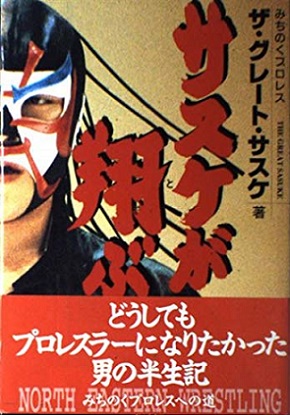
Sasuke Soars - The Great Sasuke (1995)
A biography of a man who desperately wanted to become a
professional wrestler. The road to Michinoku Pro Wrestling.
Chapter 1: Departure to Tokyo - New Japan Pro-Wrestling School days
Chapter 2: MASA Michinoku appears! - Universal era
Chapter 3: My original experience of professional wrestling - The ring is in
front of the TV
Chapter 4: I will definitely become a wrestler! - Michinoku youth record
Chapter 5: Dream trip to Mexico - Pro-wrestling training in the home of lucha
Chapter 6: The stirrings of Michinoku Pro - The light of lucha will never be
extinguished
Chapter 7: Quebrada for life - The desperate battle begins
Epilogue: I want to have fun only in Tohoku - Until the day it becomes an
entertainment culture

TAJIRI's Pro-Wrestling Wanderings - Yoshihiro Tajiri (2006)
The diary in chapters 1-8 of this book was serialized in "Weekly Pro-Wrestling" magazine as "TAJIRI's Wandering Ramblings" for 3 years and 9 months from June 2002 when the author was with WWE to March 2006 after leaving the company, and was re-edited and re-written as a new "Wandering Ramblings".
The new edition includes a newly written "Wandering Memoirs". Chapter 9, "Eddie Guerrero's Memorial Memoirs," was originally published in the December 14, 2005 issue of the same magazine. Chapter 10, a special dialogue between Great Kojika (President of Big Japan Pro-Wrestling) and TAJIRI, "7 Years of Filial Piety," was written specifically for this book.
Last updated: 2/10/26
All books listed are for sale. You can order by emailing me at bahumuth17@aol.com with with what you are interested in.
Each book is $12 dollars. I tend to mostly go through PayPal these days, but if you prefer Cashapp I can do that as well. Please make sure to send as a friend when sending through PayPal when ordering.
I have personally translated all the books listed for sale into English and will send them as a PDF file through email after purchase.
Please understand the process takes many hours for each book on my end and I have tried my best to make it as readable and understandable as I possibly can.