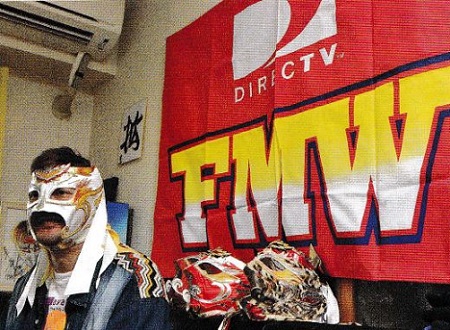
- Hayabusa, you aspired to become a professional wrestler while
attending university in your hometown.
Hayabusa: That's right. When I heard from (Mr.) Gannosuke that there was
an entrance test (for FMW), I couldn't wait any longer and went to take it. I
didn't think I could become a professional wrestler. The general entrance
regulations at the time were over 180 cm and over 75 kg, and a professional
wrestler was equal to a monstrous size. When I was in college, I was 183 cm
tall, but only about 55 kg.
- Despite that, why did you decide to take the role?
Hayabusa: In the end, it was simply because I love professional
wrestling.
-There were New Japan and All Japan, but why did you join FMW?
Hayabusa: FMW didn't have that rule. I guess it was FMW that Gannosuke
said he would join. It wasn't a specific organization that he wanted to join.
- How old were you when you decided to enter the school?
Hayabusa: I was 22 years old. I dropped out of college in my third year
and was just hanging around. After that, I got a job at my uncle's company and
had three days left to go to work, so I contacted Gannosuke and he told me that
he would be taking the FMW exam in a week. After hanging up the phone, I thought
about a lot of things. My friends who had been with me were trying to do what
they loved, so I wondered if that was okay for me. When I realized that, as I
said before, I couldn't sit still, so the next morning I packed my bags and went
to Gannosuke's house saying, "I'll take the exam with you."
- What was your parents' reaction?
Hayabusa: I ran away from home without saying anything at that time... I
took the exam on a night bus for a round trip of two days and two nights. Even
so, I didn't think I would pass.
- And then you passed.
Hayabusa: It was like a lie. I couldn't believe it. The moment I sat down
in the interview chair after the physical fitness test, Mr. (Tarzan) Goto told
me, "You passed."
- Was it your height that was the deciding factor?
Hayabusa: I think so. For a moment I was like, "Huh?" Then he said,
"What, you don't want to do it?" and I said, "No, I want to do it, but..." He
just said, "Well, I'll contact you later."
- What happened after that?
Hayabusa: Before getting on the bus back from Shinjuku, I called my
parents for the first time in a week. They said, "What are you doing? Come home
soon." I was doing the job my parents had given me, and it seemed like it was
tough. I went back to my parents' house and listened to my father's lecture for
two hours, kneeling and rubbing my forehead on the tatami mat. My mother was
crying next to me the whole time. At the end, I said, "I think what you're
saying is 100% right. But it's my life, so can't I do what I want to do?" My
father was silent for a while, then said, "Don't come back here again," and left
the room. I really felt like I was disowned.
- …
Hayabusa: In the end, I didn't even get a send-off, and I didn't get to
speak to him for a while. After my debut, my first match that was in Kumamoto,
my father came to watch. My father told me at the time, because his family ran a
business (an inn), "You're not going to make it anyway, so come back home
quickly." I was the eldest son, so he wanted me to take over the family
business.
- What was it like joining the FMW organization?
Hayabusa: I knew the training would be tough, and I knew I didn't have
the stamina, so I was okay with that, but the hardest part was the part-time
work. At the time, New Japan and All Japan had the image that if you entered a
dojo, you just practiced. With FMW, the style was to go to a part-time job that
the company had decided on, work there, and then practice.
- Was that for France Bed, which was a corporate sponsor?
Hayabusa: It was a job doing maintenance for Beds. At the time, FMW
provided me with a place to live, but I had to pay for all my utilities and food
out of my own pocket, so I was forced to go to part-time work. I'd wake up at
6am every morning, leave the Kawagoe dojo at 7am, and head to Kasukabe, where I
had a part-time job. I'd finish work at 3pm, and get home at almost 5pm. Then
I'd go buy chanko and practice from 6pm to around 11pm. After practice, I'd eat
chanko and go to bed at 2am on average. It was normal to wake up at 6am again
the next morning.
- It must have been really tough not having time to sleep. Was reality different
from your ideal?
Hayabusa: It was completely different. It was a dormitory that had been
converted from a warehouse, and we were crammed into a windowless room with
Gannosuke and I, so it was hell in the summer. We just spent every day doing
nothing, so we didn't even have the time to think about accepting that kind of
lifestyle.
- So you weren't in an environment where you could devote yourself solely to
practice.
Hayabusa: We were an independent team, so there was a tendency to say,
"Indie guys don't even practice." But we tried our best to the best of our
ability under that lifestyle. Of course I don't think we practiced enough, but
it was painful to hear such words.
- Have you ever wondered why you had to work part-time?
Hayabusa: I thought about it every day, but in the end, if I didn't like
it, I had no choice but to quit wrestling. The only way to continue wrestling
was to go to a part-time job and practice. I had no other choice. I was being
kicked out of my house, so wrestling was the only option. I was in a situation
where I had no choice but to do it in order to continue wrestling.
- How was the training at FMW?
Hayabusa: I think Goto taught me exactly what he learned in All Japan. I
was able to do some pretty solid training.
- It was a major class training, right?
Hayabusa: We weren't allowed to do anything flashy at the time. The
techniques that Goto taught me were drop kicks, flying head scissors, and body
slams. I think the only flying technique I was allowed to use was the cross
attack. It may have been because I was a student wrestler, but I was able to go
back to the basics and not go in the flashy direction. I think it was a time
when I was able to learn what pro wrestling really is.
- What was the point at which you were freed from your harsh life?
Hayabusa: It was when I no longer had to work part-time after a year and
a half of training. I remember very well the feeling of freedom and joy that I
could finally concentrate on pro-wrestling. I could live off the money I earned
from pro-wrestling. I know that I'm not really a full-fledged professional
wrestler because I know that I'm not drawing in the customers myself, but I did
feel like I was a professional wrestler.
- Having experienced both, what does student wrestling and professional
wrestling mean to you, Hayabusa?
Hayabusa: I think it's a great pride to be a wrestler. I think student
wrestling is just a hobby. Enjoying what you love. At least that's how I was. A
professional is someone who is paid to communicate something to people. I think
a wrestler is someone who is prepared and ready to communicate. We grew up
learning a lot from wrestling. I think the difference is in the sense of
responsibility when you're the one communicating it.
- What was the atmosphere like at FMW at that time?
Hayabusa: Onita said the same thing, but I think the word "family" really
fits best.
- I'm sure there were a lot of things that happened between you and Onita later
on, but what kind of leader was he in the early days of FMW?
Hayabusa: He was the one who exposed his way of life the most, and really
got everyone involved by pouring out his feelings without any calculation. I
never received any direct instruction from Onita, but the one thing that
influenced me later on was, "The babyface is only as good as the beatings he
takes." That may have been the basis of my life even after I became Hayabusa.
- In 1993, you went to Mexico. What was the process that led to your
transformation into Hayabusa?
Hayabusa: Onita just told me, "You, go to Mexico after this tour is
over." Arai (Shoichi) gave me a ticket to depart 10 days later, along with an
open ticket with no return date. I was so unprepared that I didn't know what to
do.
- Normally, I think people would be happy to hear about an overseas tour.
Hayabusa: I guess going overseas was a good way to get ahead, but at the
time, I didn't think of it that way at all. So, I had 2-3 days left of the tour
before I left, so I thought about a lot of things on the bus. My image of Mexico
is a masked man. I got interested in pro-wrestling because of Mil Mascaras, and
I'm a typical member of the generation that was obsessed with Tiger Mask, so I
admired him. I thought I'd try wearing a mask just for a little while I was
overseas, so I drew the design of the mask on the back of a receipt on the bus.
About 80% of the prototype of Hayabusa as it is now was completed. The next day,
I said to Mr. Arai, “I'd like to wear a mask when I go to Mexico...” He said,
“That's a good idea.." That's when I thought, "Oh... I see!" I thought I'd be
free when I went overseas. When I was at the dojo, the curfew was 9pm. The
moment I thought I'd be free from being under house arrest 24 hours a day, I
felt a little more positive and thought it wasn't so bad.
- When you were there, what did the promoter ask you to do?
Hayabusa: Nothing at all. Things were different when I got to LA. Even
when I got to Tijuana, there were hardly any shows going on. Anyway, since I
went across the sea, I had to bulk up, so I started going to the weight gym and
ordered a mask. About a month later, my debut match was scheduled. I don't think
my performance was perfect, but I really had that feeling, and I felt that the
FMW fans and the media were all supporting me.
- Masato Tanaka and other teammates also encouraged Hayabusa.
Hayabusa: I had to make the W*ING and foreigners believe that they could
trust Hayabusa through the matches. I was desperate to convey not only my
ability as a professional wrestler, but also that I had the right mindset as a
human being. As a result, I was injured a lot, but that didn't mean I could
whine about it. I think that's why everyone was willing to do what they had to
do internally.
- On the other hand, there is the reality of attracting spectators. Was it
different before and after Onita's retirement?
Hayabusa: The first show was a shock after all. It was in Fukaya...I
think it was a little over 500 people. I was worried about whether there would
be 10 people or not at the first show. But the final show at Korakuen Hall was
filled to capacity, partly as a celebration. That's when I got over it. I
thought, "So many people are interested in us, if we convey our feelings with
determination, they'll understand," so I performed the Phoenix Splash for the
first time in Japan. From then on, Korakuen gradually became more stable. In
inverse proportion to that, my physical condition got worse and worse. Knees,
elbows, ankles. I was out of action within a year. All of this was because we
had to make sure Onita didn't return to the ring again...I thought that it was
our responsibility.
- It's not about your feelings towards Onita.
Hayabusa: It's about the purpose of our existence. It's not about being
stubborn towards Onita, I know all too well how amazing a wrestler Atsushi Onita
is when I was his assistant, so I don't really have any feelings against him.
- Hayabusa's feelings are probably the same everywhere in the world.
Hayabusa: I think that's probably the case.
- But then Onita came back to FMW.
Hayabusa: To be honest, I was disappointed at the time. Not towards
Onita, but for my own disappointment in having made him come back... And then
Onita came back. It was the start of something completely different from what we
had been doing in the new FMW.
- It was like returning back to an era.
Hayabusa: Yes. The new FMW was not meant to reject death matches. After
all, the original electric explosion test match was Atsushi Onita. No matter
what you do, you can never beat the original. That's why the first step of the
new FMW was to first get people to imagine it with a wrestling match, and then
do a death match again, which would have more impact. With Onita's return, that
foundation was completely destroyed. It was a difficult situation. Fans who
supported the new FMW's style seemed to feel betrayed, and conversely, there
were probably some who came back because they were Onita's fans. It was
difficult for the fans, and for us too, to find the right balance. There are
differences in the positions of superiority hierarchy.
- I don't think that Hayabusa or anyone else is right. However, from Hayabusa's
position at the time, he had no choice but to hear bad things said about him
from Onita.
Hayabusa: It is true that he didn't have a good impression of Hayabusa.
- What was that about? Was it a backlash against Onita's presence, was Onita a
different person when he returned, or was Hayabusa and the others lacking in
ability at the time?
Hayabusa: I don't think it was just any of those things. It's really
weird, but there was a time when I didn't even want to see Onita's face. Onita
was doing things the same as before, but there were also things that I thought
were a little different from when I was his assistant. I was frustrated that I
couldn't do things properly, and I had a lot of different thoughts. I felt
guilty for betraying the fans who supported the new FMW, and I think I was
probably jealous of Onita, who was supported so enthusiastically.
-In those circumstances, Kodo Fuyuki took control of FMW. What kind of person
was Fuyuki to you, Hayabusa?
Hayabusa: One time I had a chance to talk at length, and I agreed with
his idea of making wrestling into entertainment. I didn't just dismiss it as
show case wrestling, but also talked about why it was entertainment. One reason
is that if you can reduce the burden on the wrestler's body, something like that
can allow me to become the one name Ace on the poster. If you can make side
stories work well to make those matches more interesting, rather than always
having matches that are full of effort, then you won't put a burden on just one
particular wrestler. I agreed with what Fuyuki said, so I was very cooperative.
- The entertainment route also started to look shady.
Hayabusa: Entertainment also started to go wrong somewhere. The
withdrawal of DirecTV was the most fatal blow, but including that part, it means
that the negative spiral will start again.
- In other words, you were counting on DirecTV's broadcasting rights fee, right?
Hayabusa: That was gone. I think that they couldn't spend money on
production, and more vulgar entertainment increased in the second half. It is
not that we were unaware of this, but we did not do anything about it. One of
the reasons why FMW went wrong at the time was that it should have continued to
be more sophisticated, but ended up becoming cheap, that's for sure.
- Then that accident happened. How do you feel looking back on it now, almost 14
years later?
Hayabusa: I think it was an accident that was bound to happen, but I'm
not to blame anyone, and speaking of what happened, I think that it was just
like everyone else stumbling while walking down the street, and that it just
happened to me in the ring at that moment. At first, I was in despair, and when
I was told that I would never be able to move from the neck down, I even wanted
to die, but little by little I started to be able to move, and now I can stand
up a little. I myself can't stand in the ring and I rarely go to venues, but I
intend to continue wrestling. And I've always had the dream of returning to the
ring someday. I'm working hard for that, too. Because wrestling has taught me
not to give up. It's very painful for me to have made the people who support me
sad because of my injury. That's why I think that if I can wear my full costume
and return to the ring again, they'll definitely think that it was good that I
loved wrestling and that it was good that I supported Hayabusa. In a year or
three years, I might suddenly get better. It might take 20 or 30 years. I don't
mind if it takes that long. In the meantime, I'll just continue to fight the
situation I'm in.
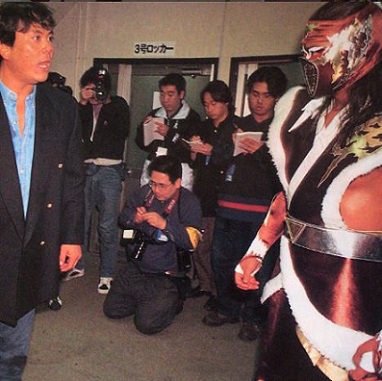
- Do you remember your first impression when Hayabusa joined
FMW?
Onita: My first impression was, "A promising newcomer with a lot of
spring has joined us." He joined the company together with his classmate,
Gannosuke.
- It was clear from the start that he had the talent.
Onita: That's right. So, I sent the young people at the time - Ichihara,
Ueno, and Hayabusa - overseas. Hayabusa was still unmasked though.
- Hayabusa went on a tour of Mexico, didn't he?
Onita: So did Ichihara and Ueno, compared to the other young guys, I
don't know why but they all shined from their time as newcomers.
- So, even when he was young, did you know that he would eventually become
someone who would lead FMW?
Onita: I don't remember if I thought that way at first, but I think he
had that much brilliance. And then, when he got injured later, I think he was
the only one feeling the pressure. He was the ace of FMW. I think he was
conflicted about whether he could bear the pressure of having to be the ace.
- When Hayabusa got injured, Onita had already left FMW.
Onita: When I heard that Hayabusa's accident happened in the ring, I
thought that he must have been under a lot of pressure.
- You distanced yourself from FMW at the time, but you still heard those
stories.
Onita: I was still curious about it. Because I gave FMW to them. If
something like that happens in that ring, how can I not be concerned? I
originally owned half of the rights to FMW. If I had insisted on it, I wouldn't
have had to let go of FMW, because handing it over was like handing over my
alter ego. But it's also true that at the time I thought I should be on my own.
- After retiring and returning, Onita left FMW, and made a huge impact by
fighting alone against New Japan.
Onita: So I thought that separating from Hayabusa and the others at that
time was probably a good thing for both of us in the end...but...
- After parting ways with Onita, FMW ultimately ended up collapsing.
Onita: Hayabusa is in that state now... Hideki Takahashi (who launched
the new FMW in April this year) also wanted to keep FMW going and create a ring
where Hayabusa could return. I agree with that idea. However, I have no idea
when Hayabusa will be able to wrestle again. Only he himself knows the details
of the situation.
- But even so, Onita also thinks it would be good for Hayabusa to return to the
ring, which is why he is currently cooperating with FMW, right?
Onita: That's right. Takahashi and I have known each other for a long
time, and that's one of the reasons why I'm joining FMW now.
- If Hayabusa could return to FMW now, that would be meaningful for FMW, right?
Onita: If Hayabusa could do whatever it takes, I would want to let him do
it, even if it was just one match, even if it was his last match, even if it was
his retirement match. That's why I want to keep FMW going.
- Although it's different from the FMW that Onita founded, Onita himself has a
special attachment to the current FMW.
Onita: Recently, the structure of the organization has changed. To be
honest, I've been half-hearted until now, but if I'm serious about it, I have to
create a women's division. FMW started with both men and women, so I'm going
back to the basics. In the current FMW, the women's division is like an add-on
to the men's division. Since it's new, the women's division has to do their
best...
- So that's how you ended up nurturing Ray, nicknamed "Female Hayabusa."
Onita: I think it would be interesting if a female Hayabusa could lead
the women of FMW, which for some reason started with the idea of Hayabusa making
a return to the ring.
- Returning to the topic of Hayabusa, the only singles match between the two
took place on May 5, 1995 at Kawasaki Stadium, where Hayabusa was the opponent
in Onita's retirement match.
Onita: I don't understand what ended up happening at the time, but it was
because Kishindoh was disturbed haha.
- Initially, Tarzan Goto, who had been with FMW since its inception, was to be
your opponent in the retirement match. But one week before the show, an
emergency occurred when Goto left FMW.
Onita: That's right. So Hayabusa suddenly returned to Japan and became my
opponent in the retirement match.
- Top wrestlers are the ones who can take advantage of opportunities that come
in such emergency situations. Although he lost, do you think Hayabusa made the
most of that opportunity?
Onita: In the end, Hayabusa's name became well known.
- In hindsight, it may have been good that Hayabusa was the opponent in that
match, instead of Goto.
Onita: In that sense, yes. To be honest, I was thinking that if Tarzan
and I had my retirement match, then Hayabusa would come back to Japan and I
would have him fight Goto next... But when Tarzan quit, things fell apart, so I
have nothing to do with it anymore.
- After Onita retired, FMW was reborn with Hayabusa as its ace. After that,
there was some awkwardness when Onita returned...
Onita: But I gave him a chance in my own way. I met Baba frequently when
he was alive. No matter what position I was in, we were master and apprentice.
When I asked Baba, “Why don't we do electric current blasting? Baba-san would
never shake his head in agreement So he wouldn't even let me enter the All Japan
ring. But I asked Baba, “What if it's Hayabusa...."
- Hayabusa was active in the All Japan Championships while Baba was still alive.
Before that, he also participated in the "Super J Cup," which was the catalyst
for his breakthrough...
Onita: I asked to get him included in that as well.
- Did you think Hayabusa had the star quality to make it in the majors?
Onita: Yes. At one point in FMW he was acting as a character called H,
but when I left I said "You should stay as Hayabusa"...
- Of the wrestlers who were Onita's disciples and grew up in FMW, Hayabusa and
Masato Tanaka were the two bests who were good enough to make it in the majors.
How did you see them as your mentors?
Onita: I think the all-around type is probably Hayabusa. Hayabusa can
handle any style, but I think Tanaka is the one who is stronger in a straight
line. Just as the first son and the second son have different personalities, the
two of them have completely different personalities. That was interesting. They
had an adversarial relationship. Then this year, they had a base again in the
FMW ring.
- The wrestling styles and looks were completely different.
Onita: However, Tanaka must have had the desire to surpass Hayabusa, like
the relationship between me and Tarzan. Even though he was the second son, he
wanted to surpass the eldest someday. Goto would always have wanted to surpass
me.
- It's great to see so many wrestlers come out of FMW, which was created by
Onita, who is known as the evil one.
Onita: The emergence of Hayabusa and Tanaka is probably history made by
FMW.
- Both of them have a track record in the major leagues.
Onita: I think these two are living proof of FMW, and also proof that
Atsushi Onita is alive.
- You had been in contact with Hayabusa, but had a more recent relationship with
Tanaka. This year, however, you have made contact with both of them in the FMW
ring.
Onita: Now that I am celebrating my 40th anniversary, I have to nurture a
successor in my mind. I am thinking of having a explosion match with Tanaka, and
one of my plans is to bring up a female Hayabusa Ray in FMW. In addition,
“"Super Fireworks" is also working on regional development and reducing
bullying. The Super Fireworks has been well received by many people who want to
see explosions in their local areas, and I would like to preserve that asset as
well.
- You have set a goal to retire when you turn 60. You still have a lot to do in
the remaining two years and two months.
Onita: I want Hayabusa to come back to the ring within the two years and
two months that I have set as my final deadline. I think it is my mission to
protect FMW in order to achieve that.
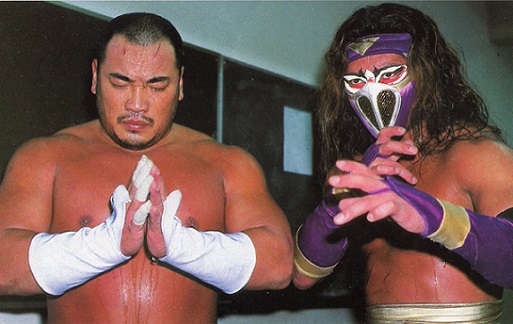
- When was your first contact with Hayabusa?
Shinzaki: Before we met for the first time in our lives, I spoke to him
on the phone when I was in New York (WWF at the time). When I was in FMW as a
Michinoku wrestler, Hayabusa was on an overseas tour and we missed each other,
but I remember that at the point Onita had probably retired and he returned to
Japan. I don't remember why we spoke on the phone, but I think we said, "We have
the same scent." I had a premonition that we would meet someday in a different
situation than the exchange between Michinoku and FMW.
- You sensed the same scent even on the phone.
Shinzaki: When we were in our lives, the wall between major and indie was
much thicker than it is now. Both Hayabusa and I had a strong desire to overcome
it, and I felt that before we even spoke, and when we actually spoke, that
feeling was conveyed, so I felt that the day would come when we would fight
against major as comrades...it was intuition.
- Your first match after returning from WWE was against Great Muta (April 29,
1996, Tokyo Dome), and just before that, the two of you were photographed in the
studio for the cover of this magazine.
Shinzaki: That was the first time we met in person. At that point, it had
already been decided that Hayabusa would be my comeback match in Michinoku after
the Muta match, so I was surprised when Weekly Pro Wrestling approached me about
it. We had made contact without even initiating the action.
- Do you remember what you talked about.?
Shinzaki: No, not at all... well, I think it was the same as now.
- The same as now...?
Shinzaki: Hayabusa without his mask makes a lame jokes. I don't remember
if he told a joke, but that was the atmosphere.
- Your one-on-one match took place in October of that year, but it ended up
being the first and last.
Shinzaki: The match itself showed that we had too many similarities
between us, so we didn't do the "swing" that people often talk about. I guess we
just cancelled each other out because we had the same strengths. So I thought
that this wasn't a relationship where we could fight. So I didn't have any
regrets about not wanting to do it again, but it was a sad match.
- Even if you're excited before you try it, there are cases where you realize
it's not what you want after you try it.
Shinzaki: In my case, that was the only case where I did that match with
Hayabusa. That's why the match remains special, and it was also big in the sense
that it established the direction of the tag team.
- In fact, the following year, you participated in All Japan Pro-Wrestling's
"World's Strongest Tag League" with Hayabusa.
Shinzaki: In those days, we traveled between three organizations,
Michinoku, FMW, and All Japan, as a pair. We would drag our bags around and
check the timetables ourselves and get on the train. All Japan and FMW are other
organizations, so I think it would have been tough not only physically but
mentally if I had gone around alone. But when I travel with Hayabusa, he becomes
a mood maker. That really helped me. Until then, I only did group activities in
Michinoku. Hayabusa is the only one who has traveled with me throughout my
active career.
- You two really are like a pair of companions.
Shinzaki: It was beautiful because we would talk about our dreams for
wrestling and had passionate discussions on the road about life. It felt like I
was traveling with friends from school. I don't have many private relationships
with any of the wrestlers, but Hayabusa is the only one I meet and eat with
outside of tours.
- Maybe it was because of those experiences, but why do you think you two got
along so well?
Shinzaki: I don't know why. We never really got angry with each other...
I just found it annoying that sometimes I have to respond to a lame joke.
--Did you feel like you were a "big brother" to Hayabusa?
Shinzaki: Yes, it feels like we are brothers.
- Going back to the topic, were you surprised when you were entered into the
Strongest Tag League?
Shinzaki: When we first entered into the Strongest Tag League, I never
thought that indie wrestlers like us would be able to participate in the
tournament. I took it as a chance that I got by teaming up with Hayabusa, but on
the other hand, I thought it was a time that was always meant to come.
- Expectations were high, but it was actually the matches between Hayabusa and
Jinsei that generated the most buzz during the tournament.
Shinzaki: This is the realization of what I had in mind when we first
spoke on the phone. Among them, the two matches that stand out the most are the
one between Kawada (Toshiaki) & Taue (Akira) in Sendai (Miyagi Prefectural
Sports Center) and the one between Misawa (Mitsuharu) & Akiyama (Jun) in Sapporo
(Nakajima Sports Center).
- With the venue packed to capacity, the audience was enthralled with every move
the two made.
Shinzaki: I was able to run through the biggest stage of my wrestling
career together with Hayabusa. It was seen as Hayabusa and Shinzaki, but to me,
if Hayabusa was the sun, then I was the moon, and I thought that was natural.
- Although Shinzaki is older, it was not chosen as Jinsei & Hayabusa, it was
Hayabusa & Jinsei.
Shinzaki: I felt that it was natural, and I never felt jealous or wanted
to change it. At the same time, that strongest tag was a landing point for the
two of us. Because we were able to sprint at full speed in a short span and
share a rich time, it was a very natural flow that we gradually teamed up when
it was necessary.
- For example, did you ever think about going into New Japan, which was
considered another major organization, or continuing with FMW or Michinoku?
Shinzaki: That kind of thing was only possible because of the momentum.
After that, we also took the Asian Tag Team Titles, but other than that, it
wasn't the trend. But nothing changed about my relationship with Hayabusa. There
was no break just because we stopped teaming up. I think that's what makes us
special.
- What was your memory of hearing about Hayabusa's accident?
Shinzaki: I remember that I was on tour in Michinoku on that day, and I
think I was contacted by someone from the media. But honestly, I don't remember
it clearly. It was such a big shock... I felt scared when I heard about it. It
was still at a stage where not much information had been spread, so I imagined
what had happened to Hayabusa. I felt scared that something like that had
happened to someone other than me, not to me. So I think that even now, my
memories of the few days since that day are still shrouded in fear.
- What was the first time you met him after the accident?
Shinzaki: It was when I went to visit him in the hospital. He was still
unable to move from the neck down... I wanted to encourage him but couldn't find
the words. Still, I felt that I had to say something, so I could only say
ordinary positive things. It was worse than I had imagined... the person who had
fought and laughed with me until just a while ago was unable to move from the
neck down. It's scary to think that this could continue for the rest of his
life. As someone who saw that, I can only say that he had an incredible ability
to recover.
- Were you still concerned about me even after he was released from the
hospital?
Shinzaki: If I heard about a good treatment, I would research it and send
it by email right away. Medical technology is evolving every day, isn't it?
Considering that, I think that returning to the ring is not a dream. So,
Hayabusa's hope of returning to the ring is also my own hope.
- The way you interact seems natural. There's a sense of distance between you
that isn't due to a relationship or obligation.
Shinzaki: Ah... It's exactly the same as the distance between parents and
siblings. That's what makes him so amazing... Sometimes I compare myself to him.
I wonder if I could live with such strength.
- Is there anything you learned from him?
Shinzaki: No, it's not so much that I have learned from him, it's that I
respect him.
- Is there anything you would like to do in the run-up to the day of his return?
Shinzaki: He often do live performances. I have been invited to perform
him. Once I invited Motoko Baba to watch me perform in Sendai, and I sang in
front of the audience, but I'd like to sing with him again.
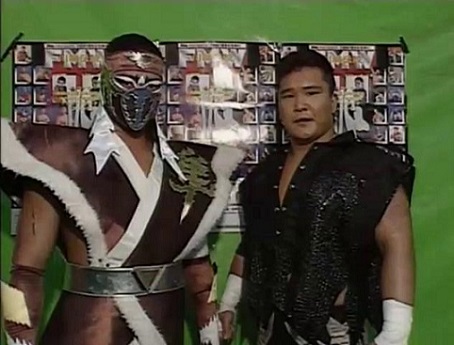
-What was your impression of Hayabusa when you started with FMW?
Tanaka: Even when I was a fan, I thought he was a really cool wrestler.
After I joined, he looked after me well and trained a lot, so he was someone I
looked up to.
-What about in terms of generations?
Tanaka: He is three or four years older than me in terms of age, so in
the end, it was Ezaki's generation, Nakagawa (Koji GOEMON)'s generation, and
then mine. (Tarzan) Goto was in charge of the joint training, but it was Ezaki,
Honda (Masashi = Mr. Gannosuke), and Nakagawa who showed me how to do it.
-Do you have any memories from back then?
Tanaka: Ezaki is a very nice person when he is alone, but when he is with
Gannosuke, he is very mischievous (laughs). Ezaki and the others were university
student wrestlers, and they all excelled in one skill. They graduated from
university and had some experience in the workforce before joining, so I didn't
know about the mischievous behavior of university students, but every day, Honda
at the dojo would say to the juniors, "Do it!" while drinking. But before we
did, Ezaki would do a dick trick, which was really funny. There was a gap
because a cool guy would do something vulgar like that. Then we were told to do
more than that, so I really wish I would have spoken out (laughs).
- That sounds like it was a pretty tough situation.
Tanaka: But there was no bullying, such as hitting, and I was sad when
Ezaki went to Mexico. After I made my debut and got really good, my good older
brother went far away.
- Did Hayabusa's departure have any impact on you?
Tanaka: At that time, I was too busy with my own things. I wondered what
Ezaki would do before Onita (Atsushi)'s retirement match (May 1995). It was
decided that (Tarzan) Goto and others would leave, so I was worried about what
would happen to the retirement match card, and after Onita retired, I wondered
what Hayabusa would do. At that time, I didn't know anything about the company,
so I remember asking referee Ito, "What will Ezaki do?" Then I remember feeling
relieved when I heard him say, "He says he's staying." I wondered who I should
follow if Onita retired and Goto and Ezaki were gone.
- What kind of senior was he outside the ring?
Tanaka: He often took me out to dinner parties and things like that.
There are a few people I got to know through Ezaki who I still keep in contact
with. Ezaki often took young wrestlers out to dinner as well. Dragon Kid still
meets Ezaki more than I do, and Milano Collection A.T. was also looked after by
him when he was in FMW. He also took new apprentices who had just joined. At
FMW, there was a senior like Ezaki, so I don't think there was any sneaky
bullying or doting.
- When did you start to think of Hayabusa as an opponent?
Tanaka: I guess it was when we started being called the two biggest aces
after the new generation. But I didn't feel like we were in the same position.
After the new generation, Hayabusa had a series of injuries. He kept flying even
when he was injured. Ezaki-san often said something like "The audience comes to
see Hayabusa with that style, so I have to fly even if I am injured" - something
like Hayabusa's mission.
- As someone from the same organization, how did you feel about it?
Tanaka: Ezaki is a good athlete, so if he kept jumping like that, he
would hurt his elbows and other parts of his body. People said that if he
continued doing it in that style, he would have to miss shows. So there was an
atmosphere that if the people around him didn't try harder, they wouldn't be
able to let Ezaki rest in peace. After the new company was formed, people like
me and Tetsuhiro Kuroda were coming out quite a bit. Even if Ezaki was absent,
we had to protect FMW. I think all the wrestlers probably thought that.
- Was Hayabusa a big presence in Tanaka's growth process?
Tanaka: Even Ezaki and I didn't have that much experience, we carried FMW
on their backs behind the great Atsushi Onita. I saw that, so after the new
company was formed, I thought I had to try harder too.
- Were you not aware of him as an opponent at that time?
Tanaka: He still felt like a friend. The two matches I had with Hayabusa
that left a strong impression on me were when I wrestled with him before going
on a tour to ECW and when I wrestled with him in Komazawa after I came back.
Those two matches left a strong impression on me.
- What kind of match was it in May '98 before you went to ECW?
Tanaka: It was like a send-off match, the crowd was excited, and people
around me said it was a good match. I think it was on the cover of Weekly Pro.
It was a picture of me getting beaten (laughs).
- What kind of wrestler was Hayabusa as an opponent?
Tanaka: He was taller than me, had a well-proportioned body and could
spin around like that, and he was very athletic and strong. He was like Kota
Ibushi (if you'd call him that today). I respected him even when he was younger.
Whatever he did, he was cool.
- Did you have FMW Hayabusa in your mind during your ECW trip?
Tanaka: Not at all. After coming back from ECW, I was showered with
cheers, and the way people looked at me changed, so I thought I had to have
matches with Ezaki. Instead of Ezaki being above me, I wanted to put myself out
there more, so that I could stand next to him. I had gained confidence after
going to ECW.
- So that was your mindset when you had the singles match at Komazawa in May
2000?
Tanaka: Yes. After all, if you think it's okay to be under someone else,
you won't grow. Even if you don't think you've surpassed them, you have to have
the mindset that you want to surpass them. I was allowed to go overseas, and if
that doesn't change, it's meaningless. When Ezaki-san and Jinsei-san (Shinzaki)
came to ECW, I was still here, so I thought I had to put on a more exciting
match than those two. That's when the rivalry started. Even if I couldn't beat
Hayabusa in terms of coolness, I honestly didn't want to lose in terms of match
content.
- How did Hayabusa deal with the entertainment route?
Tanaka: Hmm... I don't know about that. At the time, Mr. Ezaki was one of
the upper echelons, but I wasn't part of it at all. The company might have been
annoyed that I wasn't on the entertainment route. Mr. Ezaki treated me normally,
but I don't think we ever talked about that.
- And so Tanaka said goodbye to FMW.
Tanaka: There was a day when people who couldn't keep up with the
entertainment route had to tell me by this date, and I suddenly decided to quit.
If I had consulted with Ezaki at that time, it might have been a little
different. But at that time, I was apart of the Complete Players, so I was with
my friends there even in the waiting room.
- How did you feel when you heard about Hayabusa's injury?
Tanaka: I heard about it during the All Japan tour, I contacted someone
and went to visit him in the hospital.
- About the accident...
Tanaka: I guess he was overworking his body out of a sense of
responsibility. I saw the video, and if he was an ordinary wrestler, he would
have fallen over the moment he stepped off the ropes. But Ezaki has great
athletic ability, so he was able to turn around to some extent even in that
condition. If it were me, I would definitely have fallen off my feet. It was a
shock. I thought I would never wrestle in FMW again, but I still wanted to have
another match with Ezaki someday.
-I would like to see you have another match with him
Tanaka: Now that my fighting style has changed, I wonder what would
happen if we did it. In the past, I was about 20kg heavier than now, so I relied
on strength, but now I have stamina and mobility, so I can compete with Hayabusa
in speed. I wanted to fight as the current Masato Tanaka. But even now, he has
outstanding star quality among the so-called indies. Since I became a
professional wrestler, I don't think professional wrestlers are cool, but I
think Hayabusa is cool.
- If Ezaki hadn't gotten injured, which organization would he be in now, and how
active would he be? It makes my imagination run wild.
Tanaka: I still think about that. He was good friends with Mitsuharu
Misawa, so maybe NOAH, or maybe New Japan...
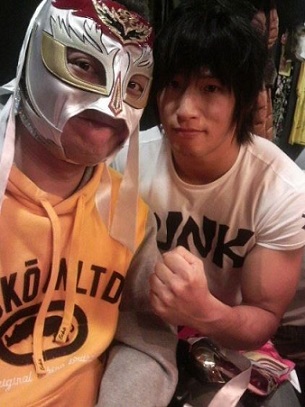
Kota Ibushi, who debuted in 2004, has been using the Phoenix
Splash as his finishing move ever since. He respects the move perfected by
Hayabusa and continues to use it under the same name. What does Hayabusa mean to
Ibushi? I think the first time I saw Hayabusa was in the Super J Cup match
against Jushin Thunder Liger (April 16, 1994, Ryogoku Kokugikan). I think that
was a shock to everyone. He was doing the tope con hilo while wearing his gown
when he entered the ring. Since then, I watched FMW and I'm a big fan of
Hayabusa. I also remember Onita (Atsushi)'s retirement match (May 5, 1995,
Kawasaki Stadium) very well.
My favorite was the match against Gladiator. I was shocked by the Super Awesome
Bomb, but Hayabusa countered with a Super Frankensteiner. It was amazing.
Hayabusa was the first to perform a beautiful, authentic Phoenix Splash. It made
what the original Tiger Mask and Liger had imagined a reality. I had never seen
it on video before. I practiced as soon as I saw it. I bought quite a few of
Hayabusa's videos.
I think it was around the end of sixth grade. I jumped from a tetrapod in the
sea. It was about 180 centimeters high. I was imitating the shape of landing on
the concrete ground from a height higher than the corner post. I was at a time
when I liked doing dangerous things like that. There was a 5-centimeter-wide,
5-meter-long board between the two banks. It was a dangerous height if I fell.
Even walking across the board was dangerous. I miraculously managed to cross
there on my bicycle. There were about five boards, and I fell halfway through
the second one. My heel came off (laughs). My shoes were destroyed. The concrete
below was gravel and my heel was cut quite deep, and the inside of the wound was
completely white. It was intense pain, but not enough to make me cry. I was
curled up for about an hour.
My friends were worried, saying, "Ibushi fell?!?!", "That's too bad," and
"Should we go to the hospital?" I couldn't come down, so I took a detour. After
that story, I said, "No, I'll do it again." Compared to this experience, doing
the Phoenix from the top of a tetrapod is not dangerous at all. That's how it
felt. Also, the ring is softer than concrete because there is a mat. Now I use
the Phoenix and I don't feel scared.
The first time we met was around 2009. Hayabusa suddenly invited me to an
izakaya, but I was nervous at first, so I called (Michael) Nakazawa and we went
together. Daichi Kakimoto was there too. Then Nakazawa started selling tickets
to other customers, saying, "I'm going to do an Anus Explosion match for the
first time at Ryogoku next time" (laughs). The second time, I was invited to
Hayabusa's house. Shingo Takagi was there too. There was also a foreigner who
had Hayabusa's entrance pose tattooed on his back. The four of us spent ages
watching videos of Hayabusa. Flying techniques usually change over time, but
Hayabusa's movements from about 15 years ago are still amazing. They are still
considered the pinnacle of techniques. I sometimes find myself incorporating
Hayabusa's movements without realizing it.
The movements in my flying techniques are heavily influenced by Hayabusa. There
are very few people who use the same move as a finisher from their debut match.
I've been using it for over a year. The Phoenix is Hayabusa's technique, so I
use it with the same name. I have a lot of respect for him and will continue to
use it with care. (Ibushi)
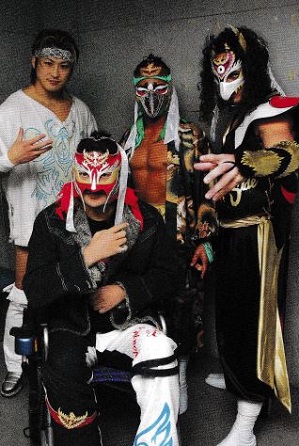
Ezaki-san has been very kind to me since my FMW days, so I
finally understood the situation. For information on how we met, please refer to
this week's Human Story. So when I heard that he had been injured at Korakuen 14
years ago, I couldn't believe it. I first found out about it in Weekly Pro. I
had to read about it in the article, so I didn't know how serious the injury
was. Of course, I knew that he had hurt his vertebrae, but I couldn't imagine
how serious it was. After that, I got information from various people, and I
really wanted to go and visit him, so even though only family members were
allowed to visit, I asked if I could go to the intensive care unit, and I was
admitted to the intensive care unit.
At that time, he had a high fever for about a week, and bacteria had gotten into
his heart, so it was a difficult time, but he said to me, "I'm sorry." He seems
to have lost consciousness at the time, so he doesn't remember, but all I could
do was cry. It took a while from then on, but he calmed down and has come to
this day. I was always indebted to Mr. Ezaki, and in the past, we often went out
drinking until the morning. Mr. Ezaki was also the one who taught me how to
drink. He was strict about alcohol, and I remember him telling me, "It's rude,
so drink with respect and taste it properly."
He was also the one who built the foundation for me as a man and a person. I
entered this industry when I was 18 years old, and I was naive. The wrestling
world is unique. He taught me a lot of things, and other than that, there were
many things I learned from watching, including the matches. That's right.
Without Mr. Ezaki, I definitely wouldn't be who I am today. It may sound cheesy,
but I think I wanted to be like his younger brother.
The most memorable event in the ring was when I played Hayabusa at Shinjuku FACE
on January 24, 2009. That was the best. I was Hayabusa, PAC (now Neville) was
Darkside Hayabusa, and (B×B) Hulk played H. The mask was made to my size, and
Ezaki did the eye makeup. I was completely transformed into Hayabusa. Kuroda
(Tetsuhiro) also said that I looked just like Ezaki.
Also, Ezaki wrote a song for me for my 10th anniversary. Ezaki-san was
originally a singer, and when I asked him, he said, "Okay, let's work together."
So I wrote the lyrics and Ezaki-san composed the music for them. From there it
actually became an album, with five songs sung by me and Ezaki-san. We also did
live shows. It wasn't a national tour, we went from Kyushu in the south to
Hokkaido in the north, and after the game we went straight to the live house and
sang in front of everyone. I'm not good at singing, and I'd never done music in
general, so I could hardly keep the rhythm, but I sang with a tambourine.
I would forget the lyrics, so I made mistakes, and a fan at the time made a
lyric sheet for me, and I would sing while looking at it. It was chaotic, but
fun. I'm really glad that he always looked out for me. Now he's doing so well,
and I am really happy about that. For us, matches are works of art, they're art.
Since he is in a state where he cannot leave a new art behind, I think we have
created it instead and inherited his genes, or rather, his way of thinking. He
is happy about it as if it were his own achievement, and I think it is a way of
giving back to Ezaki.
My fighting style is heavily influenced by (Hayabusa). The pose I did when
calling out in the early days of Dragon Kid was an arrangement of the Hayabusa
pose, and I also incorporated the split-legged entry from the apron into the
ring. The same goes for the techniques during the match. I was taught and
advised by Ezaki about the Quebrada, and I always played matches with Hayabusa
in mind. The Hayabusa I know is the one who was moving around energetically, not
the Hayabusa of today. I think that Ezaki himself has not given up on his
return, so we are moving forward little by little. My dream is to eventually
stand in the ring together. (Kid)
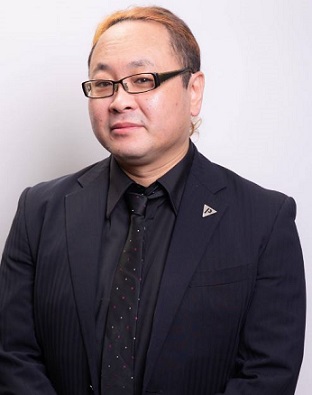
In February 1991, when Hayabusa and Mr. Gannosuke joined FMW,
Atsushi Onita had already established his popularity as the "Tearful Charisma"
after his electric explosion death match the previous year and his successful
first anniversary event in November.
Although he was calling himself an indie wrestler, he was already becoming a
presence that surpassed major league wrestlers. The presence of heroes in the
Japanese pro-wrestling scene was passed down from Rikidozan, Giant Baba, and
Antonio Inoki. From the late 1980s, this was passed down to stars such as Jumbo
Tsuruta, Genichiro Tenryu, Tatsumi Fujinami, Riki Choshu, and even Akira Maeda
of the up-and-coming UWF.
Onita's popularity on a par with these was due to his uniqueness. He attracted
the viewers with his appeal. Star wrestlers have ambition before the fans want
them, they produce themselves, and when that is accepted, they gain support.
Rather than being naturally born, Japanese professional wrestling has produced
aces for each era.
In the midst of all this, Hayabusa, as his fate was decided by others, found
himself carrying FMW on his shoulders. Originally, he wore the mask only for
Mexico, but when he participated in the "Super J Cup", he made a tremendous
impact in his match against Jushin Thunder Liger, and he could no longer go back
to being Eiji Ezaki.
He himself had come up with many ideas for the image of Hayabusa, but in the
end, it was the reaction of the fans that decided whether it was right or not.
When people imagined a phoenix flying above the ring, he honed his original
aerial killing technique to respond to that.
What was required of Hayabusa was a "heavyweight who could fly". In other words,
when Ezaki put on the mask and became a person, he was destined to be a person
who would carry the dreams and wishes of others. The position of ace of the new
FMW did not come about because he wanted to be spontaneous.
After Onita retired, there was only one person with comparable charisma. Before
joining FMW, Hayabusa did not attend college and lived a hand-to-mouth
lifestyle. Although he did some student wrestling, it was a time when the
barrier to entry was much higher than it is now, so he never even thought he
could become a professional wrestler. A young man from Kumamoto who had no
dreams for the future and could not decide what career he wanted to pursue,
heard that his fellow student wrestler Gannosuke was going to apply to FMW and
fell into self-loathing, thinking, "What am I doing...?"
In reaction, he decided to go to Tokyo with him. Ezaki's life changed completely
when he met Hayabusa. "I want Hayabusa to be a hero to me too." Even back then,
when Hayabusa spoke about the incarnation that continues to fly, carrying the
fate of the group and the hopes of the fans, he always took a third-person
perspective. It was clear that it was another self that was supporting his
injured body. Unlike the active stars up until then, Hayabusa was the first
passive hero who was supported by the dreams of his fans.
So the viewers could project themselves into his fights and share his pain and
suffering. It has been almost 14 years since the accident on October 22, 2001.
It is natural that his presence has always lived on among those who saw his
phoenix dance in real time, but he is also recognized as a legendary man by
wrestling fans all over the world who do not know him from that time.
He receives emails from unknown fans in countries he has never heard of,
encouraging him by saying, "I was moved by the video. I look forward to the day
you return to the ring." A few years ago, when he went to SummerSlam in a
wheelchair, the McMahon family, John Cena and other WWE superstars came out to
welcome him.
Although he sacrificed himself for others and ended up on that day, Hayabusa
does not regret becoming a professional wrestler. This is because he has an
unshakable belief that "if I had taken another path, I would not have been able
to feel so fulfilled in my life."
However, those who entrusted their dreams to Hayabusa must still be feeling some
remorse somewhere. And they must be waiting for the day when they can wipe that
feeling away and step into the ring in full costume again. Many of the wrestling
media who shared that era have always thought that they had to do something for
Hayabusa. Despite this, even now that he has left the ring, we are still
encouraged every time we see his miraculous recovery. As Hayabusa himself said
in the recently published "FMW Fierce Fighting History," Hayabusa is still a
wrestler who fights in the present tense, even though he is not in the ring.
Therefore, I believe that it is our mission to continue writing match reports
called life until the day he descends again as a phoenix. (Ken Suzuki)