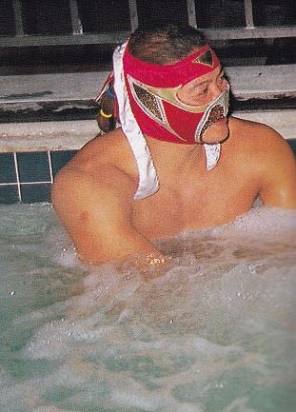
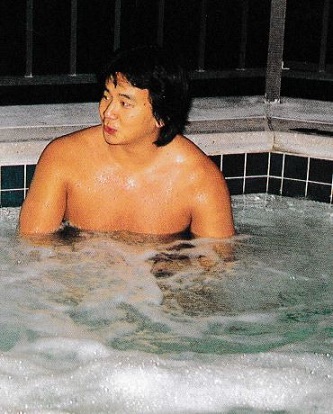
Hayabusa & Osamu Nishimura conversation in a hot tub at a Florida hotel on February 14, 1995
Hayabusa: Nice to meet you, I'm Hayabusa.
Nishimura: I'm Nishimura, who boycotted the Tokyo Dome (bitter smile).
Nice to meet you.
Hayabusa: I've just come to America,
Nishimura, I heard you have been here for about two years?
Nishimura: I came here in August 1993. I was focused on getting in shape,
and matches were secondary. By chance, I had an offer and did just one match in
April 1994...it was my first match in about 10 months, and I'd gained 15kg. I
wasn't particularly struggling, but I gradually started to feel anxious about
not having a match.
Hayabusa: I just had my debut match in
America (February 14th in Tampa), but I hadn't had a match since mid-December,
and I'd only been doing Mexican style for about a year, so I was anxious.
Originally, I wanted to train in America, but I ended up in Mexico. So in the
end, I was selfish and came to America. Of course, my first priority is to get
in shape for the heavyweight division, but I'd also like to get a feel for pro
wrestling here, so I'd like to start wrestling in matches here and there from
now on.
Nishimura: I'm also in a small independent company now... In a big
company, the pay and schedule are tight and your name will rise, but if you're
an independent, if you do 15 matches a month, you have to contact 15 companies,
and if you do a bad match, they won't use you again, so it's a great learning
experience. The level of wrestling is incomparable to Japan, and the style is
different, but I learn a lot from other aspects besides the matches.
Hayabusa: If you're in Japan, you have to
keep up with the schedule given to you by the company...There were times when I
couldn't make a living in Mexico, so I think it doesn't hurt to do things like
booking matches myself.
Nishimura: Liger is good at both glamour and strictness. "If it comes
down to it, I will never lose."
Hayabusa: I had a match with Liger last
year, and he's really strong.
Nishimura: Other than ECW, the promotions are really small, and in Tampa
there are only 30-40 people in the audience, and they might be drunkards who
don't know anything about wrestling, but even so, you fight in a way that makes
them want to come and see you again... You should feel a sense of responsibility
for taking the main event, and it should be a learning experience. That's why
when I didn't come back to the Tokyo Dome on January 4th, people said to me,
"You didn't come back because you didn't have confidence," but it wasn't because
I didn't have confidence, I just wanted to gain experience and experience. You
can't make fun of American wrestling after all.
Hayabusa: Being the main event and having to
attract customers on your own responsibility allows you to do something you
can't experience in Japan. It also leads to your income. If you can't convince
30 to 40 customers, I don't think you'll be able to make it back to Japan. When
I was in Mexico, I sometimes watched American wrestling on TV, and I've been
watching it since I came here, and there are many different types of wrestlers
there. You have individuality. Even if it's something given to you by the
company, it's up to you to make the most of it, and in that respect I feel you
have a sense of professionalism.
Nishimura: I was watching the Royal Rumble the other day... Of course The
Undertaker was great, but Bret Hart had the power to draw the crowd in.
Hayabusa: When I was in LA and watched WWF
at the Sports Arena, I saw Bret Hart, Shawn Michaels... I felt that there was
something different about people who had a solid foundation in the sport.
Nishimura: In that sense, I guess a Japanese person needs a character to
be able to surpass America, but I'm not that particular about it. I still have a
lot to work on, and I'm still just starting out. And since I'm from New Japan,
it's difficult because I don't really want to be particular about a character.
Even if you compete in wrestling, there are times when the audience doesn't want
that.
Hayabusa: But in the end, what's needed to
make the fans happy and come back is the foundation. On May 5th, Onita will
retire, and FMW will have to run with Goto and the rest of us... To be honest,
we're no different from other independents in Japan. But we want to survive and
make our organization as good as Onita's. So right now, I want to absorb
everything.
Nishimura: If you look at it from both the glamorous and strict sides,
Liger is skilled. He has that "I will never lose if it comes down to it."
Hayabusa: I had a match with him last year,
and Liger is truly a strong man.
Nishimura: I think it's because of his fiery temperament, but I think
that's how a wrestler should be.
Hayabusa: Actually, I was once told that I
have a similar style to Nishimura, and it always bothered me. I'm currently
fighting as Hayabusa, but eventually I want to move up to the 115kg (253 pounds)
heavyweight class and fight under the name Eiji Ezaki. I'll do my best with the
desire to become the top. When that time comes, I want to face Nishimura in the
ring, so I look forward to it.
Nishimura: I want to become a wrestler who is called a "Bali fighter" and
look back at the origins of real fights and real wrestling, and that's the same
in America. As a part of New Japan, I can't let the strength of Japanese
wrestlers that my great predecessors have built up go down, and I think it's my
duty to do a strong style. And if I get to the top... if I get the chance, I'd
like to fight Ezaki and people from other organizations. When that time comes,
I'll show you!
Hayabusa: If Nishimura has the pride of New
Japan, I have the pride of an independent. If we ever have a match, I'll use my
independent pride to win. If Nishimura has the pride of New Japan, I have the
pride of an independent. If we ever have a match, I'll use my independent pride
to win! (Recorded late at night on February 14th)