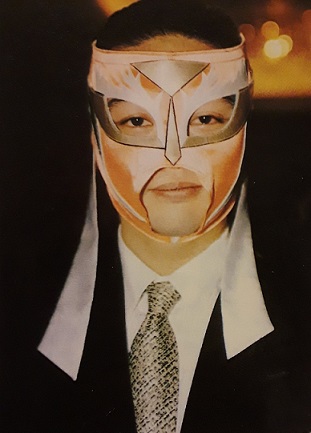
Hayabusa by Mizusa Tomiro
His entire body was paralyzed. He wanted to jump off his fourth-floor hospital room and die, hoping for relief. But he couldn't. On October 22, 2001, Hayabusa failed a moonsault (La Quebrada) from the second rope into the ring. He injured his cervical vertebrae and was rushed to the hospital. Hayabusa was exceptional and cool even before his debut.
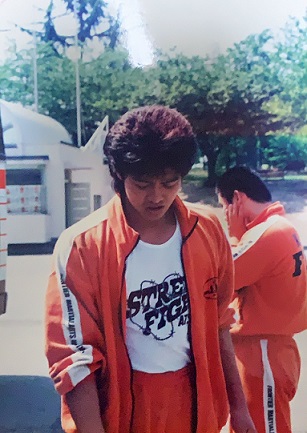
When he was a member of the Kumamoto University of Commerce Pro Wrestling Club, the ring was simply four volleyball poles wrapped around a commercial rope, but he was able to perform a moonsault from there. He decided to take the FMW entrance exam two days before the actual test. He heard his best friend, Mr. Gannosuke, was taking the exam, so he tagged along on the same overnight bus. He rushed to write his resume at a coffee shop after arriving in Tokyo the morning of the test, but he passed and became a professional wrestler.
A few years later, Masato Tanaka was left bleeding profusely by The Sheik in his first few fights. Suddenly, some body rushed in like a gust of wind and tried to hit Sheik with a chair. "What are you doing to my son?" she screamed. It was Tanaka's mother, who had come to watch the fight. Suddenly, someone grabbed the chair and stepped in between them. It was fellow young fighter Eiji Ezaki, the unmasked Hayabusa. "Don't worry. We'll protect you," he said. "If you hadn't stepped in then, my mother would have been a bloody Daruma doll (wry smile)."
After a triumphant return to Japan for the legendary "1st Super Cup," Ezaki made a sudden breakthrough as Hayabusa. However, Hayabusa himself barely fought during his training in Mexico. "So, when I was offered to compete in the J-Cup, I turned it down twice. But then, on the third international call, they said, 'It's already been decided,'" Hayabusa recalled. Moreover, the moment he heard his opponent would be Jushin Thunder Liger, his mind went blank. How could he possibly compete when he only had one or two matches a month?
New Japan Pro-Wrestling sent him a flight home in business class, his first time ever. Upon his return, New Japan arranged for him to stay at the Keio Plaza Hotel. He was allowed to use New Japan's dojo for practice, and was again surprised by the high-quality ingredients in the chanko, a dish that even its deliciousness added to the pressure. To top it off, Koji Kanemoto, who was with him in Mexico, said, "Are you going to fight with Liger? Hehehe, if you perform poorly, you'll be crushed." It was a tease. Liger, for his part, said, "It's a triumphant return. Come on, come on!" His smile was repulsive. Moreover, on the morning of the race, Hayabusa overslept and was 10 minutes late for the wrestlers bus to depart. It was his own fault. Even if it wasn't, it seemed like the other wrestlers were looking down on him. (He had no choice but to accept it...!)
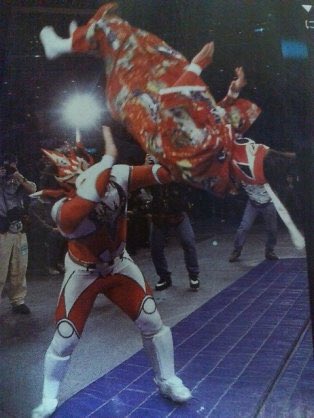
As a result, Hayabusa, still in costume, unleashed a no-touch tope con hilo. He also demonstrated Liger's original hold, the Shooting Star Press. Hayabusa has no memory of the match itself. Liger had beaten him so severely that he was semi-conscious and ultimately defeated. In fact, rewatching the video, you can see Hayabusa's unsteady footing midway through the match. However, I was surprised when I saw the magazines reporting on the match. The match was featured in several color pages, including a series of photos of the Shooting Star Press. Liger himself unreservedly praised Onita, saying, "I envy Onita for having such a young man."
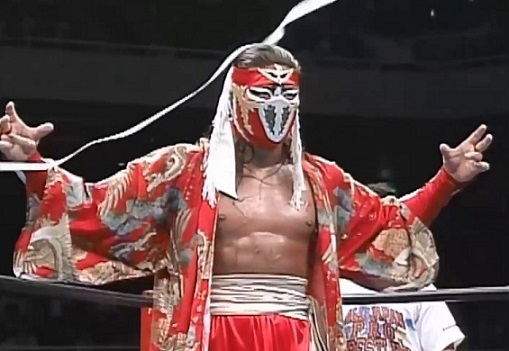
However, this move was actually a trial run, never even practicing it. There was no doubt that Hayabusa was a rare wrestler with a genius aptitude. He attracted attention, and in the following year's Weekly Gong fan popularity poll, he came in third among Japanese wrestlers after Muto and Misawa. In April 1997, he joined the long-established and major All Japan Pro Wrestling. In September, he achieved his long-cherished dream of facing off against Kobashi Kenta for the first time. Furthermore, at the end of the same year, he won the World's Strongest Tag League. He entered the All Japan Pro Wrestling Tokyo Dome show with Jinsei Shinzaki. The following May, he formed his first trio with Giant Baba (including Kentaro Shiga).
In February 1999, he teamed with Jinsei to win the All Japan Pro Wrestling Asia Tag Team Championship, a prized title. It had been two years since the belts had been sold to a duo in another promotion. Carl Smokey Ishii of the Kome Kome Club once designed a one-night-only mask and costume (July 27, 1997).
It was rumored that Joey Ramone, lead singer of the legendary punk band The Ramones, was a huge Hayabusa fan. He briefly transformed into a different character, H (Eichi), and at the time, he got a tattoo of the Hayabusa wing on his chest. It was an inseparable part of him. Without a doubt, Hayabusa was a young, huge star in the world of professional wrestling, especially in his own promotion, FMW.
In October 2001, Hayabusa led the series. Starting on the 17th, he traveled to Aichi, Niigata, and Kyoto, each one day apart, all sleeping in the bus. After the Kyoto show, he again slept in the bus and arrived at Korakuen Hall the next morning, where the match was to be held. They could have disbanded here and arrived at the venue in the evening, but Hayabusa, who lives in Tokyo, was unable to move. He had a fever of 38 (100.4) degrees. He rested on the bus, but his fatigue was still there. He left his tonkatsu set meal for lunch, even though it was his favorite food.
Since becoming a wrestler, he has easily eaten more than two people's worth, so it had been more than 10 years since he last left food uneaten. However, there was no way he could miss the match that night. And of course, his turn was the main event. It was a one-on-one match against the Mammoth Sasaki. And in that match... Hayabusa suffered serious injuries. He missed his footing as he attempted a moonsault from the second rope.
Considering the difference in height, he should have fallen on his back, but he forced himself to turn and ended up falling on the top of his head and neck. Due to a cervical spine injury, he lost feeling from the neck down. He couldn't move his arms or legs. So he couldn't move. Even if he tried to throw himself out the window of his fourth-floor hospital room, that was impossible. It was time to bite his tongue. He tried to give up and die, but cords were strung all over his body. A nurse was ready to come rushing in if there was any change in his heart rate. This made instant death impossible. When his relatives came and held his hand, he couldn't feel it. But his ears were still intact, and he could hear his doctor speaking to those involved. "He's in a vegetable state," "Hemiplegic for the rest of his life"... The horrors continued.
The following January, Mr. Gannosuke, an old acquaintance and one of the two leading stars of FMW, was hospitalized with a leg injury. On February 14th, FMW went bankrupt. All I could do was shed tears. Two months later, a cassette tape arrived. It belonged to FMW president Shoichi Arai. It was filled with endless apologies for the company's collapse and words of concern for Hayabusa's condition. It was a few days later that President Arai's suicide was reported. He began to shout more angrily. He took out his anger on innocent nurses. He became enraged at the doctor who tried to check by palpation whether his nerves were responding. "If you say you don't know, then you don't know!"
That's when he realized. (I can still talk...!) On May 5, 1995, former FMW ace Atsushi Onita retired. Hayabusa, who faced him in front of a sold-out crowd of 58,200 at Kawasaki Baseball Stadium, was to lead the new FMW from the next series onward.
What was surprising was that the first match of the opening show, on May 17th at Fukaya City Gymnasium in Saitama, started with less than 10 people in attendance (!). By the time the main event began, the crowd had finally gotten to around 400 people, but this was reality. Hayabusa was in the main six-man tag team, and immediately after the match began, he performed a triangle jump quebrada the outside of the ring. He performed one spectacular flying move after another. At the end of the show, he shouted, "I will never let FMW die!" and appeared to be crying.
I saw Hayabusa at a local venue during this series, and he literally unleashed his aerial techniques. He also performed the dangerous triangle jump, the Quebrada, seemingly without a second thought. He instinctively checked ringside. There were no reporters. No cameramen. No TV cameras, of course. In other words, Hayabusa was flying solely for the fans who had rushed to the event. There were probably fewer than 100 people. After a arduous regional tour, the final match of the series, held at Korakuen Hall, was sold out. "It's a celebration, right?" Hayabusa asked, but his face couldn't hide his joy.
That day, Hayabusa unveiled a move for the first time. It was the Phoenix Splash, a move previously attempted by the original Tiger Mask and Jushin Thunder Liger, but either never made public or ended in failure. He wanted to live up to the fans' expectations for the new FMW. As the organization gained support, the number of injuries resulting from flying moves also increased. Even when Tanaka, mentioned earlier, said, "We'll cover for you, so don't push yourself too hard," he responded: "If Hayabusa didn't fly, it wouldn't be Hayabusa. The fans came to see him fly. Don't worry, little brother."
Ever since the incident with his mother, Hayabusa, five years his senior, has always called Tanaka this playful and cheerful nickname. Mr. Gannosuke, who left FMW just before Onita's retirement and would return a few years later to wrestle Hayabusa, was surprised. "His sense of responsibility was incomparable to the Eiji Ezaki I knew."
After a month and a half in the hospital, his fingers began to move. He was also happy when his back, which had been bedridden for a long time, began to ache. Pain equals nerve recovery. Around the same time, he was able to move his neck downwards. He still had no feeling, but his body was still there, and he felt relieved. Then he saw wings. It was the Hayabusa tattoo on his chest. He felt a spark in his heart. (That's right. I'm Hayabusa...!)
From then on, Hayabusa demonstrated his incredible resilience. After four months in the hospital, he was able to sit up, and feeling returned to his arms. He'll never forget the joy he felt when he shifted and saw the hospital floor for the first time. A few days later, he was able to stand on both feet while holding onto the bed frame.

In August 2002, Gannosuke brought together former FMW wrestlers to launch a new promotion, WMF. Hayabusa, in a wheelchair, made the opening speech and, with the assistance of an attendant, even managed to stand on his own two feet. Hayabusa underwent daunting rehabilitation, which continued into the future, but he recalls: "You're Hayabusa, right? If you're Hayabusa, you'll do your best here!" Gannosuke was shocked by the change in Hayabusa's personality when he returned to FMW, and as an old friend, he said: "He was originally a fun-loving guy, and the type who didn't want to take on responsibility. (Omitted) I think that as he continued with Hayabusa, Eiji Ezaki's personality was drawn to Hayabusa" (Weekly Pro Wrestling, April 5, 2016 special edition).
"It's okay to go slowly. Let's move forward one step at a time." "This is the beginning of a new you." Hayabusa sings in a bar. Despite being wheelchair-bound, he has begun performing live, making use of his beautiful voice and songwriting ability. The song titles included "All I Had Was a Dream," "Believe in Myself," and "To You Who Are Working Hard." Drawing on his own painful experiences, he appealed to everyone to look forward together. Before long, the venue was packed with people standing.
Of course, many of Hayabusa's fans were already fans, and during his MC, he shared some behind-the-scenes stories from the world of professional wrestling, bringing plenty of laughs. He had over 50 original songs, and over the course of about 10 years, he had performed more than 80 concerts. One day, a visitor from overseas visited. The half-Japanese woman spoke in halting Japanese, "Joey was a big fan of yours when he was alive." A reporter from an American music magazine had come to convey the sentiments of Joey Ramone, who had already passed away. After listening to the live performance, she shed tears and said, "It was a wonderful song. When I return to Japan, I'll take your CD to Joey's grave..."
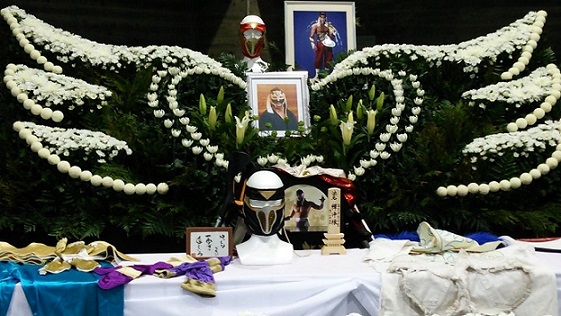
Hayabusa died of a subarachnoid hemorrhage on March 3, 2016. On that day, he was scheduled to hold his ninth live concert at a familiar venue. Upon seeing his body in his hometown of Kumamoto, Gannosuke said, "He had a calm expression... I couldn't sense any pain or anything like that." At the private funeral altar in his hometown, the wings of a phoenix were drawn with flowers. A portrait of him, wearing a Hayabusa mask, was placed in the center.